
Stats & Analysis
Every deck in MTG Rack comes with a live analytics panel that updates as you add or remove cards. From mana curve charts and color distribution to draw probability calculations and price breakdowns, the stats view gives you the data you need to build better decks. This page covers every analytics feature available in the deck editor sidebar and the dedicated stats tab.
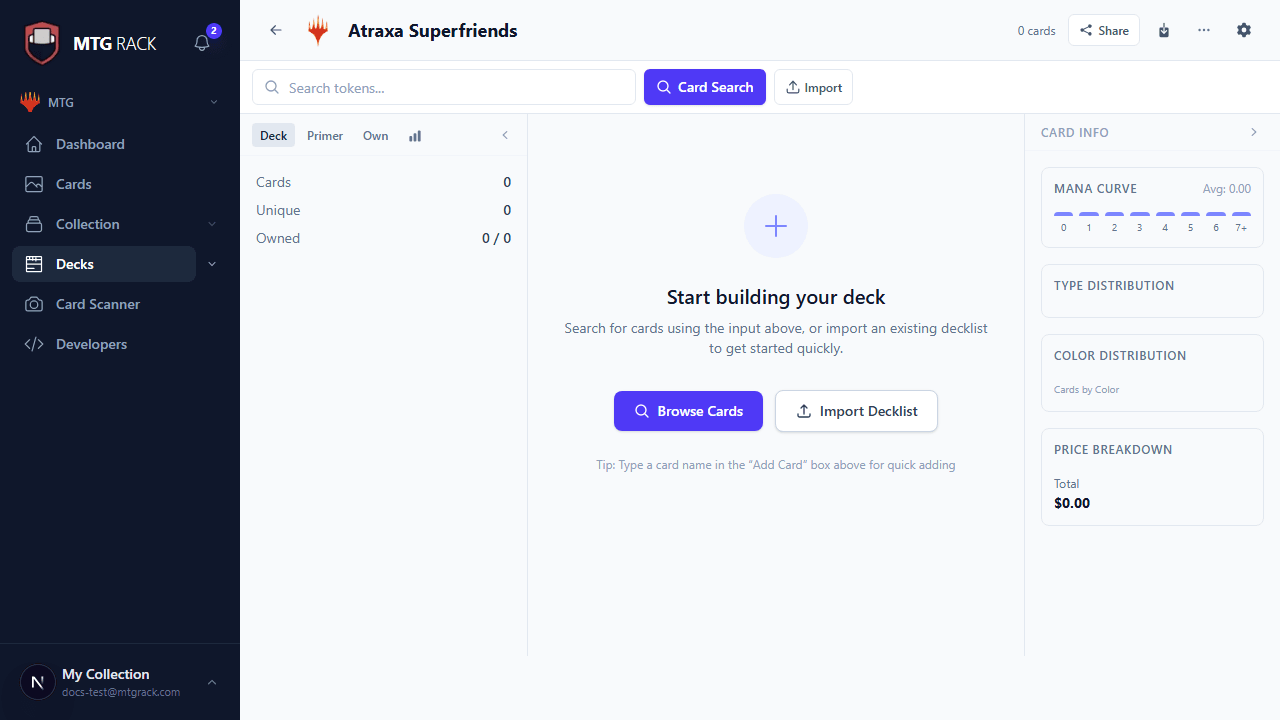
Mana Curve Analysis
The mana curve chart is a bar chart showing the distribution of non-land cards across mana values. Each bar represents a mana value (0, 1, 2, 3, 4, 5, 6, 7+) and its height corresponds to the number of cards at that cost. The bars are color-coded by the predominant color of cards at each mana value, giving you a visual sense of which colors contribute to each point on your curve.
Hover over any bar to see a tooltip listing every card at that mana value, grouped by type. A well-constructed curve typically peaks at 2-3 mana for aggressive decks and 3-4 mana for midrange strategies. The chart updates in real time as you edit, so you can immediately see the impact of adding or removing a card.
Color Distribution
The color distribution pie chart shows the breakdown of colored mana symbols across all non-land cards in your deck. This is not simply counting how many red cards you have — it counts individual mana symbols, so a card costing 1RR contributes two red pips while a card costing 2R contributes only one. This pip-based analysis is the most accurate way to determine how your mana base should be weighted.
Use this chart to guide your land split. If your color distribution shows 40% white and 60% blue, your lands should roughly mirror that ratio. The chart includes colorless and hybrid mana for complete accuracy.
Card Type Breakdown
The type breakdown section shows how many cards of each type are in your mainboard:
- Creatures — the backbone of most decks; includes creature count and percentage of non-land cards
- Instants — your reactive spells
- Sorceries — your proactive spells
- Artifacts — includes both mana rocks and utility artifacts
- Enchantments — auras, sagas, and global enchantments
- Planeswalkers — loyalty-based threats
- Lands — shown separately with a recommended count based on your average mana value and format
- Battles — the newest card type from March of the Machine
Each type also shows its share as a percentage of the total deck. Tap any type to filter the decklist to show only cards of that type, making it easy to review a specific category.
Price Breakdown
The price breakdown shows the total estimated cost of your deck based on current TCGplayer market prices sourced from Scryfall. The breakdown splits the cost by section (mainboard, sideboard, maybeboard) and highlights the most expensive cards. Each card shows its individual price, and the total updates as you add or remove entries.
Use the price breakdown to identify budget-friendly alternatives. Cards flagged as expensive often have cheaper printings or functional reprints — click the price to see all available printings sorted by cost.
Average Mana Value
The average mana value (AMV) is the mean converted mana cost of all non-land cards in your mainboard. This single number is one of the most important indicators of a deck's speed. Aggressive decks typically have an AMV under 2.5, midrange decks land between 2.5 and 3.5, and control or ramp decks can go above 3.5. The AMV is displayed prominently at the top of the stats panel and updates instantly as you edit.
Landbase Analysis
The landbase analyzer evaluates your mana base against your deck's color requirements. It answers the question: "Do I have enough sources of each color to reliably cast my spells on curve?" The analyzer considers:
- Total land count and whether it matches the recommended range for your format and curve
- Color sources per color — how many lands produce each color of mana
- Untapped sources — how many of your color sources enter untapped, which matters for early plays
- Utility lands — lands that provide non-mana benefits (card draw, creature generation, etc.)
The optimizer suggests adjustments when it detects imbalances — for example, if you have 15 white sources but 20 white pips in your spells, it will flag that you may struggle to cast double-white spells on curve and suggest adding more white sources.
Mana Source Analysis
Beyond just lands, the mana source analysis counts all sources of mana in your deck, including mana rocks (Sol Ring, Arcane Signet), mana dorks (Llanowar Elves, Birds of Paradise), and ritual effects (Dark Ritual, Cabal Coffers). This gives you a complete picture of your deck's mana production capacity, which is particularly important for Commander decks that rely heavily on non-land ramp.
Optimization Tools
Deck Readiness Panel
The readiness panel checks your deck against your collection to tell you which cards you already own and which you still need to acquire. Each card in the deck is marked as one of:
- Owned — you have enough copies in your collection (shown in green)
- Partial — you own some but not enough copies (shown in yellow, with the shortfall noted)
- Missing — you do not own any copies (shown in red)
At the top of the panel, a summary shows the total number of cards owned versus needed, along with the estimated cost to complete the deck based on current market prices for the missing cards. This makes it easy to plan purchases and know exactly what you need to buy.
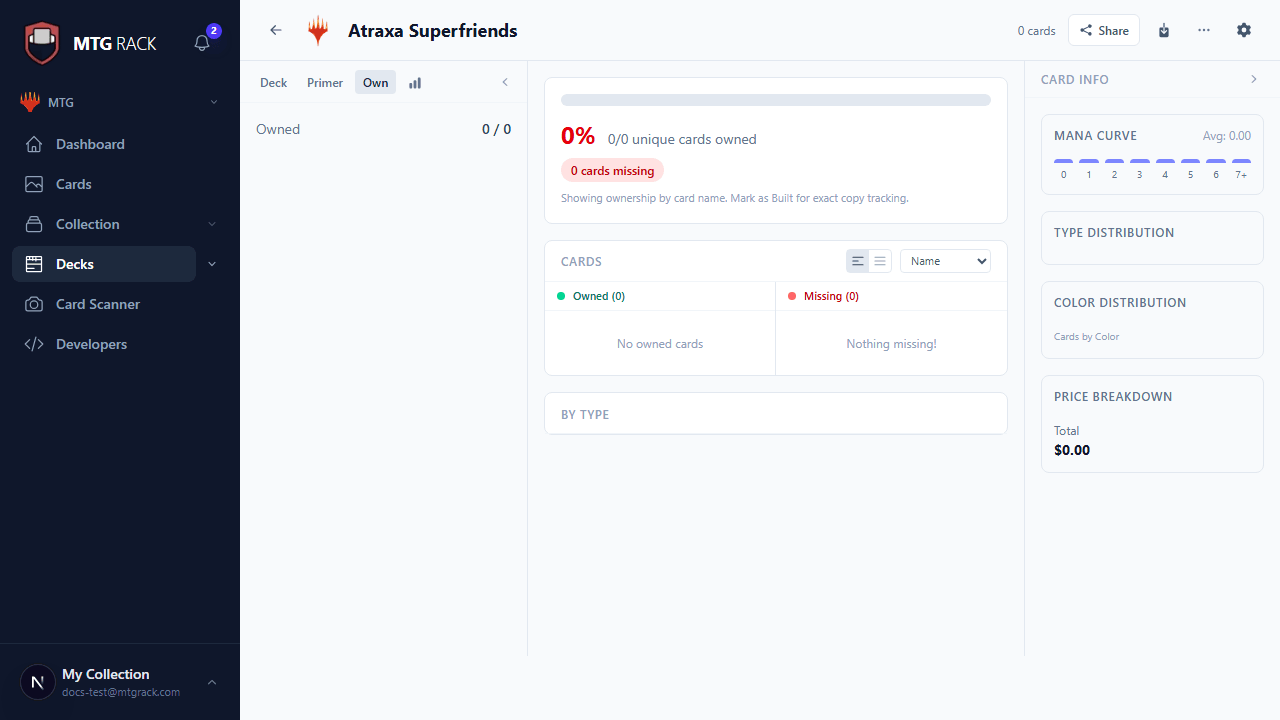
Missing Cards Tracker
The missing cards list is a filtered view of the readiness panel that shows only the cards you do not own (or do not own enough copies of). You can export this list as a shopping list in text format, copy it to your clipboard, or send it directly to a TCGplayer mass-entry search. The list includes prices so you can prioritize purchases by cost or importance.
Keep Your Collection Updated
Next Steps